
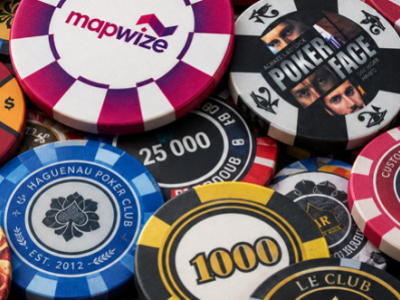
Chips with your name, your colours and your own denominations: that is what turns an ordinary poker game into a real club night. Ceramic is the material of choice for customisation: it lets you print the whole chip, from the centre to the edge, with a sharp and lasting finish. But between the 39.5 mm and the XL 43 mm formats, the numbered or UV options, the texture, the make-up of your chip set and the artwork preparation, there are many choices to make. This guide compares every option, with figures, so you can order the right set first time.
Why choose ceramic for custom chips?
There are several ways to customise a poker chip, but ceramic stands out on four points.
- Full-surface printing: ceramic is printed by sublimation. The inks are embedded in the material across the whole chip: front, back and edge. Your design is not limited to a central label; it covers the chip from rim to rim.
- Lasting quality: because the ink is part of the chip, there is no sticker to peel off, no edge to lift and no coating to flake. The colours keep their brightness game after game.
- Counterfeit-proof chips: each design is unique and exists only for you. Nobody can slip a chip bought elsewhere into your set, a decisive argument for a club or a tournament with prizes.
- A real card-room chip: ceramic stacks perfectly, handles easily and makes that crisp sound players love when chips knock together.
That is why ceramic is the choice of clubs, casinos and brands that want an object worthy of their image.
Ceramic, ABS sticker or clay sticker: the detailed comparison
Our customisation range offers three technologies. Sticker chips work differently from ceramic: the chip is made in a catalogue colour and your design is printed on a round sticker applied to the centre. The edge and the rim stay those of the original chip.
| Criterion | Ceramic 39.5 mm | ABS 8 Spots with sticker | Clay Sun with sticker |
|---|---|---|---|
| Diameter | 39.5 mm | 40 mm | 40 mm |
| Thickness | 3.3 mm | 3.3 mm | - |
| Weight | 10 g | 12 g (metal insert) | 14 g |
| Technique | Sublimation into the material | Printed sticker | Printed sticker |
| Customised area | Whole face, back and edge | 31.6 mm sticker in the centre | 26 mm sticker in the centre |
| Printed area per face | About 1,225 mm² | About 784 mm² | About 531 mm² |
| Customised edge | Yes | No (original colour and spots) | No (original colour) |
| Base colours | Unlimited (everything is printed) | 10 colours | Sun range |
| Security | Unique design, numbered and UV options | Sticker can be copied | Sticker can be copied |
| Indicative lead time | About 5 weeks | About 1 week | Depends on the sticker order |
What the figures tell us:
- Surface: one face of a ceramic chip offers about 2.3 times the printed area of a 26 mm clay sticker, and more than 1.5 times that of a 31.6 mm ABS sticker. For a detailed logo, a photo or a complex design, the difference is striking.
- Weight: ceramic is not the heaviest. At 10 g, it is lighter than clay (14 g) or weighted ABS (12 g). Players who want above all a heavy chip in the hand will prefer clay. Those who prioritise the visual result, stiffness and sound will choose ceramic.
- Lead time: the ABS sticker chip is the express solution, ready in about a week. Ceramic requires a made-to-order production of several weeks.
In short: choose ceramic for a club, a prestige chip set, a gift or a brand campaign. Choose ABS with sticker for an urgent event or a large volume on a small budget. Choose clay with sticker if weight in the hand is your first criterion.
See custom ceramic chips · ABS sticker chips · clay sticker chips
The 4 models of custom ceramic chips
The 39.5 mm ceramic chip: the casino standard
This is the reference size for casinos and clubs: 39.5 mm in diameter, 3.3 mm thick and about 10 grams. It is comfortable to hold, stacks stay stable and the chip is easy to handle for betting and chip shuffling. Front, back and edge can be customised independently. It is the right choice for the vast majority of projects, and the only model that lets you order just 50 chips per design.
Custom ceramic poker chips 39.5 mm
The XL 43 mm chip: 18% more surface
At 43 mm, the XL chip offers about 1,452 mm² per face, i.e. 18% more printable area than the 39.5 mm. In practice, a logo 25 mm wide in the centre of a standard chip can grow to 27 mm on an XL, with more space around it. The XL size shows off detailed logos, photos and long texts, and gives real presence on the table. It is ideal for the high denominations of a chip set, for a promotional item or a gift that needs to make an impression. Same options as the 39.5 mm: front, back and edge printing, smooth or textured finish.
Note, however, that XL chips do not stack evenly with 39.5 mm chips. If you mix both sizes in one set, reserve the XL for one or two clearly identified denominations.
Custom XL ceramic poker chips 43 mm
The numbered chip: traceability for clubs
The same 39.5 mm ceramic chip, with an added individual, sequential number, for example from 0001 to 1000. Each chip carries a unique number, making it easier to track bets, spot a missing chip and manage the inventory of a club or a regular tournament circuit. The number is visible and is part of the design.
Custom numbered ceramic poker chips
The UV chip: invisible security
For card rooms and casinos, the UV chip includes an ultraviolet marking invisible to the naked eye, revealed only under black light. The design stays intact, but every chip can be authenticated in seconds with a UV lamp. It is the most discreet anti-counterfeit protection. This model can be ordered from 500 chips.
Summary table of the 4 models
| Model | Diameter | Area per face | Customisation | Security | Who it's for |
|---|---|---|---|---|---|
| Ceramic 39.5 mm | 39.5 mm | About 1,225 mm² | Front, back, edge | Unique design | Home games, clubs, gifts, events |
| Ceramic XL | 43 mm | About 1,452 mm² | Front, back, edge | Unique design | High denominations, promotional items, gifts |
| Numbered ceramic | 39.5 mm | About 1,225 mm² | Front, back, edge + unique number | Visible traceability | Clubs, tournament organisers |
| UV ceramic | 39.5 mm | About 1,225 mm² | Full design + UV marking | Invisible authentication | Casinos, card rooms |
Numbered or UV: which security option?
The two options meet different needs. The standard chip is already counterfeit-proof thanks to its unique design: these options go further.
| Criterion | Numbered chip | UV chip |
|---|---|---|
| Principle | Unique number printed on each chip | Invisible marking revealed under black light |
| Visibility | Visible to everyone | Invisible to the naked eye |
| What it allows | Inventory, chip tracking, spotting a missing chip | Authentication, spotting a counterfeit |
| Check | Read the number directly | UV lamp |
| Impact on the design | The number is part of the artwork | None |
| Ideal for | Clubs, tournament circuits, associations | Casinos, card rooms, high-prize tournaments |
For a club that mainly wants to know where its chips are, numbered chips are enough. For an organisation that must guarantee the authenticity of bets without changing the design, UV is the right option.
What can you customise on a ceramic chip?
Front and back
Both faces are customised independently. You can put the denomination and your logo on one side, and a pattern, a slogan or your club name on the other. The most effective approach: one face common to all denominations (your logo or identity) and one face that changes with the value, so chips are recognised at a glance.
A poker chip reads in three zones:
- The centre: the most visible area, for the logo or a large denomination.
- The ring: the band around the centre, ideal for circular text (club name, date, slogan).
- The rim: the outer border, where you place the colour inserts or patterns that identify the value in a stack.
The edge
This is ceramic's major asset. On a 39.5 mm chip, the edge is about 124 mm long and 3.3 mm high. That is enough for text, denominations, a phone number or a website address. It can also carry a border pattern: when chips are stacked, the edge is what you see, and well-chosen edge designs let you identify each value in a stack without breaking it down.
Pattern alignment
We can align the patterns on the faces and the edge so the design continues from one face to the other over the rim. This is what gives chips that much sought-after "casino" look, with colour inserts that seem to run right through the chip.
Texture: smooth or textured
| Criterion | Smooth | Textured |
|---|---|---|
| Feel | Soft, elegant | Slightly grained |
| Grip | Standard | Better, the chip slips less between the fingers |
| Colour rendering | Very bright | Slightly more matt |
| Handling | Pleasant for betting | Ideal for chip shuffling and tricks |
| Who it's for | Gifts, brand items, premium look | Regular players, clubs |
Chip or plaque: which format for high denominations?
Casinos use rectangular plaques for the highest amounts. We offer a customisable ceramic poker plaque measuring 53 x 85 x 3.3 mm, sublimation-printed on both faces and the edge, with a matt finish.
| Criterion | Chip 39.5 mm | XL chip 43 mm | Plaque 53 x 85 mm |
|---|---|---|---|
| Area per face | About 1,225 mm² | About 1,452 mm² | About 4,500 mm² |
| Typical use | All denominations | High denominations, promotional item | Very high denominations, gift, trophy |
| Effect at the table | Casino standard | Gets noticed | Guaranteed "private room" effect |
A prestige set often combines all three: 39.5 mm chips for low and mid denominations, a few XL chips or plaques for the highest. The plaque is also an excellent commemorative item: end-of-season trophy, farewell gift or tournament souvenir.
Custom ceramic poker plaque · all custom plaques
Building your chip set: how many chips and which denominations?
Before ordering, ask yourself three questions: the maximum number of players, the game format (cash game or tournament) and how many different denominations you need. Here are three typical configurations.
Home game for 6 to 8 players: 300 chips
| Denomination | Quantity |
|---|---|
| 25 | 100 |
| 100 | 100 |
| 500 | 50 |
| 1,000 | 50 |
4 denominations, 4 designs: the simplest configuration, ideal for a first set.
Tournament for up to 10 players: 500 chips
| Denomination | Quantity | Use |
|---|---|---|
| 25 | 100 | Small blinds in the early levels |
| 100 | 100 | Blinds and small bets |
| 500 | 100 | Core of the starting stack |
| 1,000 | 100 | Medium bets |
| 5,000 | 50 | Later levels |
| 10,000 | 50 | End of tournament, colouring up |
Club with 2 to 3 tables: 1,000 chips
| Denomination | Quantity |
|---|---|
| 25 | 200 |
| 100 | 250 |
| 500 | 200 |
| 1,000 | 200 |
| 5,000 | 100 |
| 25,000 (XL or plaque) | 50 |
These breakdowns respect the minimum of 50 chips per design and multiples of 25. They are starting points: we adjust them with you according to your blind structure.
Choosing a colour for each denomination
There is no mandatory standard, but casinos follow a widely recognised convention: white for the lowest values, then red, green, black, followed by purple and yellow or orange for the highest. Using this code helps players find their way instantly. In any case, choose colours that are strongly contrasted from one denomination to the next: a player must be able to tell a stack of 500 from a stack of 1,000 without leaning over the table, even in dim lighting.
Quantities and prices: how does it work?
- Minimum per design: on the 39.5 mm ceramic chip, each design (so each denomination) can be ordered from 50 chips, in multiples of 25. You build your set freely.
- Single order: order all your chips at once. The total quantity sets your unit price: 500 chips split across 6 denominations get the 500-chip price, not the 50- or 100-chip price.
- Volume pricing: the unit price drops at each quantity tier (200, 300, 500, 1,000, 2,000, 5,000 chips). Between 100 and 5,000 chips, the unit price is almost halved.
- UV chips: minimum of 500 chips.
- Plaques: from 10 identical plaques, quote above 100.
Tip: allow a 5 to 10% margin on the low denominations. They circulate the most and are the easiest to lose, and a later reprint costs more than a small surplus on the initial order. If you are close to a tier, compare: a few extra chips are sometimes enough to reach the next tier and lower the price of the whole order.
Preparing your artwork: what you need to know
No designer? A simple description is enough: texts, denominations, colours, logo. Our design team creates the mock-ups for you. If you supply your own files, here are the points to follow:
- Formats: preferably PDF, AI or PSD. A vector logo guarantees the sharpest result.
- Resolution: at least 300 dpi at actual size for photos and images. A logo taken from a website will be blurry when printed.
- Colours: printing is done in four-colour process (CMYK). Supply your files in CMYK to avoid colour shifts between the screen and the chip.
- No metallic colours: gold, silver or copper cannot be printed as metallic. A gold will be rendered as a matt golden tone. Bear this in mind if your brand guidelines use gilding.
- No relief: printing is flat. Engraving or embossing effects are not possible, but well-crafted artwork (shadows, gradients) can create the illusion.
- Readability: the denomination must be readable from a metre away. Avoid very thin fonts and very small text, especially on the edge, where the available height is no more than 3.3 mm.
- Margins: keep key elements (value, logo) away from the edge, and treat the rim as a pattern area rather than a text area.
The most common mistakes
- Choosing colours that are too similar for two neighbouring denominations (light blue and dark blue, red and orange).
- Making the denomination too small in favour of the logo.
- Using a low-resolution logo taken from a website or social network.
- Planning gilding or a metallic effect, which cannot be reproduced.
- Ordering denominations separately: the unit price is calculated per order, not on the cumulative total.
Discover our graphic design service
Production steps and schedule
- Get in touch: by phone, email or WhatsApp, to define the model, quantities and denominations.
- Order: you order all the chips at once on the website.
- Artwork: you send your files or your brief, and we prepare the mock-ups.
- Proof approval: you receive a proof to approve designs and quantities. We make adjustments until you are happy with the result.
- Production: sublimation printing, then a check of each batch (print, alignment, stacking).
- Delivery: allow about 5 weeks after proof approval. You are notified by email when the order ships, with a tracking number.
| Step | Indicative duration |
|---|---|
| Brief, mock-ups and revisions | A few days to 2 weeks, depending on your feedback |
| Production and delivery after proof approval | About 5 weeks |
| Total to plan for | 6 to 8 weeks |
For a tournament, a wedding or a dated event, start your project at least 6 to 8 weeks in advance. If your deadline is shorter, the ABS sticker chip, made in about a week, is the fallback solution.
Ceramic chips, and not just for poker
A custom ceramic chip is a solid object, pleasant to hold and one that people keep. It is also an excellent communication medium:
| Use | Customisation idea | Recommended format |
|---|---|---|
| Promotional item, trade show, product launch | Logo on the front, message or QR code on the back, website on the edge | XL 43 mm |
| Original business card | Contact details on the back, logo on the front, phone number on the edge | 39.5 mm or XL |
| Drink tokens (bar, festival, company party) | Event name and type of drink, unique counterfeit-proof design | 39.5 mm |
| Voucher, gift card | Amount and terms, numbering for tracking | Numbered |
| Play money (casino night, live role-play) | Values and the event's visual universe | 39.5 mm |
| Wedding, birthday, stag or hen party | First names, date, photo | 39.5 mm, XL or plaque |
| Everyday goodies | Chip mounted on a ring, logo on both faces | Chip keyring |
The chip keyring uses a 40 x 3.3 mm ceramic chip, drilled and fixed to a metal ring, customisable on both faces and the edge. It can be ordered from 100 identical pieces.
Custom chip keyring · all chip keyrings
Caring for your ceramic chips
- Cleaning: a slightly damp microfibre cloth, possibly with a drop of mild soap, then dry immediately. No abrasive products or solvents.
- No dishwasher: hot cycles and harsh detergents are not suitable.
- Storage: in a rack or a case, sorted by denomination, to avoid knocks and scratches between chips.
- Handling: ceramic stands up very well to use, but a fall onto a hard floor can chip it. Play on a mat.
Complete your custom set
Chips in your image deserve a consistent set: custom dealer buttons and card guards, custom gaming mats or even a custom gaming table. To store and carry your chips, discover our empty cases and storage. And for cards, see our selection of poker cards. The full range is in our custom chips and items section.
Frequently asked questions
What is the minimum order for custom ceramic poker chips?
On the 39.5 mm ceramic chip, each design can be ordered from 50 chips, in multiples of 25. UV-marked chips can be ordered from 500 chips, and plaques from 10.
What is the difference between a ceramic chip and a sticker chip?
Ceramic is printed into the material over the whole surface, front, back and edge. A sticker chip receives a label in the centre (31.6 mm on ABS, 26 mm on clay): the edge and the rim stay those of the original chip.
Should I choose the 39.5 mm or the XL 43 mm format?
The 39.5 mm is the casino standard, ideal for all denominations. The XL offers 18% more printable area: it is perfect for high denominations, detailed logos and promotional items.
Can the edge of ceramic chips be customised?
Yes. Front, back and edge are customised independently. The edge can carry text, denominations, a phone number or a border pattern, aligned with the faces or not.
What is the production lead time?
Allow about 5 weeks after proof approval, i.e. 6 to 8 weeks in total including the design work. For an urgent need, ABS sticker chips are ready in about a week.
Can gold or a raised logo be printed on a ceramic chip?
No. Sublimation printing is flat and in four-colour process: a gold is rendered as a matt golden tone, and engraving or embossing effects are not possible.
What is the difference between a numbered chip and a UV chip?
A numbered chip carries a visible unique number, ideal for traceability in a club. A UV chip includes an invisible marking, revealed under black light, to authenticate chips without changing the design.