
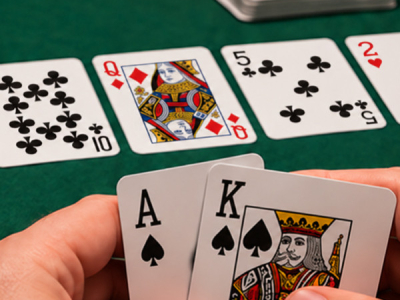
Texas Hold’em is the most widely played poker variant in the world, in clubs, casinos and at home: each player receives two hole cards and combines them with five community cards to make the best five-card hand. How does a game work? How much should you bet, when should you raise, and what happens when a player goes all-in? This guide explains the Texas Hold’em poker rules step by step, with worked examples, the most common disputes and a method for running your first tournament with friends.
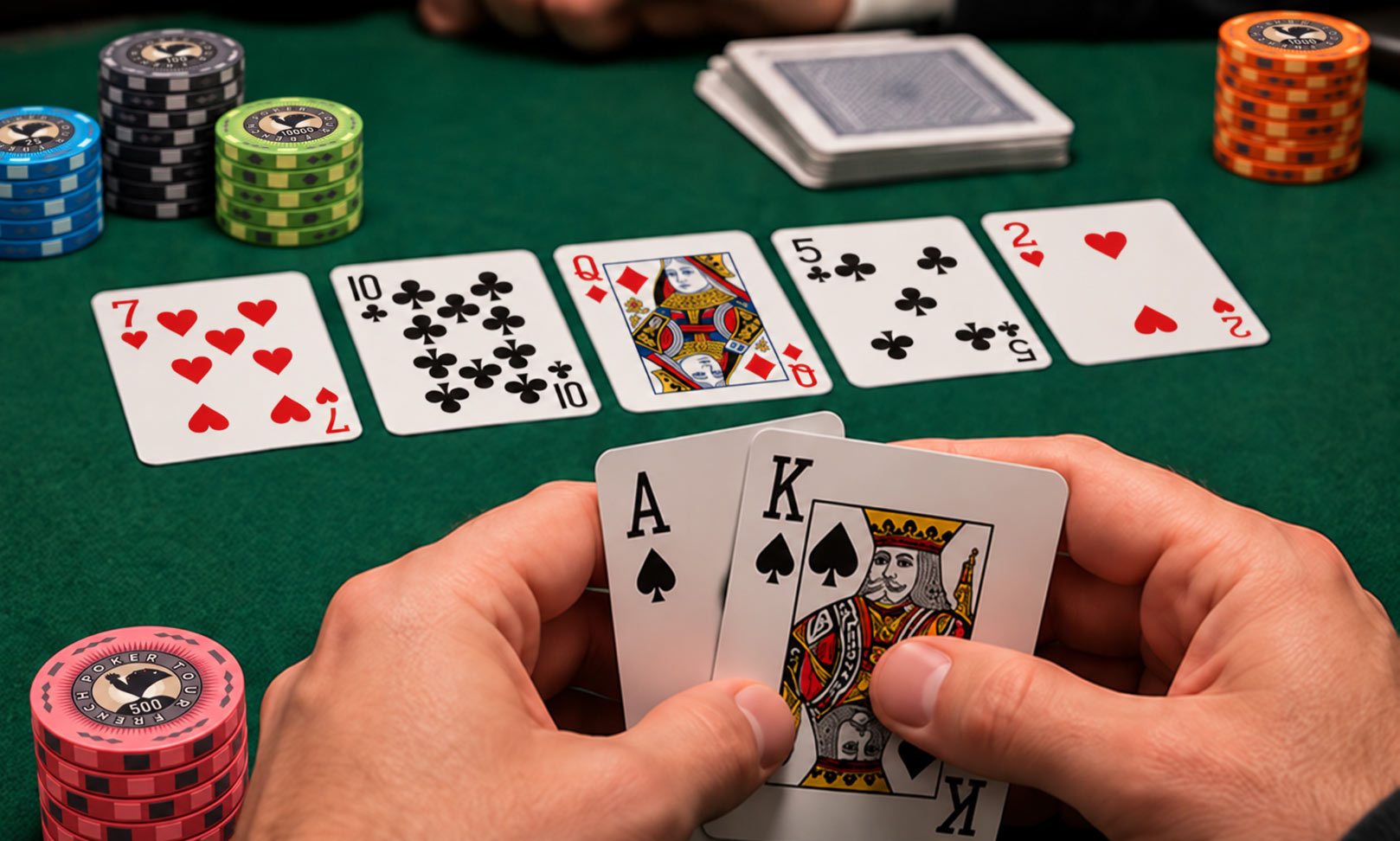
In short: 2 private cards, up to 5 community cards, 4 betting rounds and two ways to win: show the best five-card hand at showdown, or make every opponent fold before that.
Contents: Basics · Equipment · Blinds · How a hand plays out · Hand rankings · Ties and kickers · Betting · Side pots · Example · Positions · Starting hands · Odds · Disputed situations · Formats · Running a tournament · Glossary · FAQ
1. What is the basic idea of Texas Hold’em?
Texas Hold’em is played with a 52-card deck without jokers, by 2 to 10 players (usually 9 in tournaments). The dealer deals two hole cards face down to each player. Five community cards, known as the board, are then revealed gradually in the middle of the table: three on the flop, one on the turn and one on the river. A betting round takes place before the flop and after each of these stages.
At showdown, each player makes their best hand of exactly five cards from the seven available (their two cards + the five on the board), using zero, one or two hole cards. The pot can also be won before showdown: if all the other players fold, the last player left wins without showing their cards. That is what makes bluffing possible.
There are several betting structures. The most common is No Limit (you can bet your whole stack at any time). You will also come across Pot Limit (maximum bet equal to the pot) and Limit (fixed amounts). This guide describes No Limit unless stated otherwise.
2. What equipment do you need to play poker?
A home game requires a 52-card deck, chips to represent bets, a dealer button and a comfortable surface to deal on.
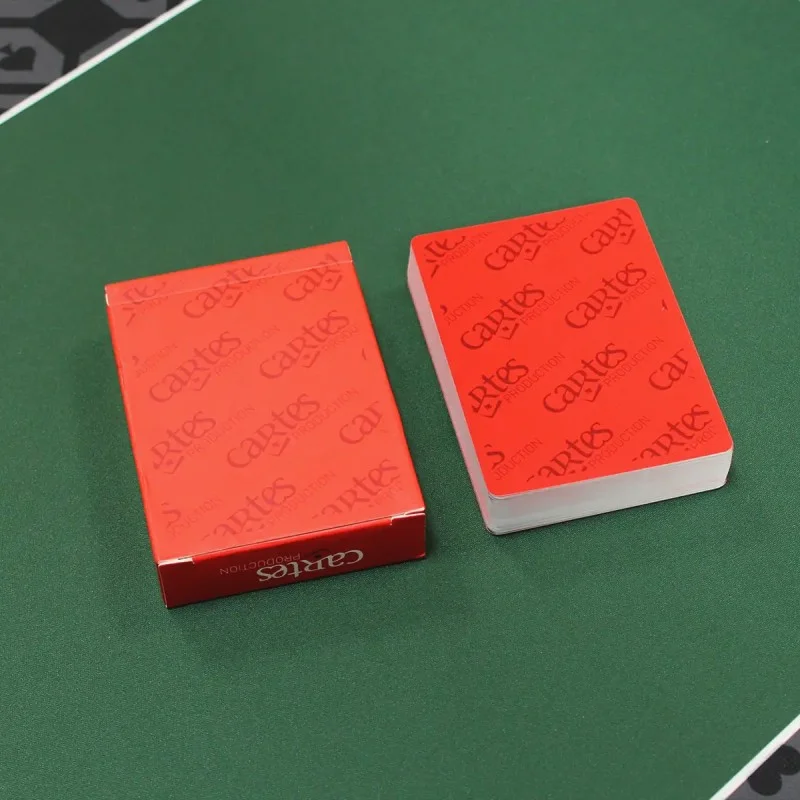
- Cards: choose 100% plastic cards, which do not mark and withstand hundreds of shuffles. A jumbo index (large numbers) makes the board easy to read for every player. Have two decks with different backs: while one is being dealt, the other is shuffled.
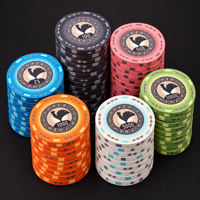
- Chips: allow around 20 to 25 chips per player spread over 4 colours. A 300-chip case is enough for up to 6 players, a 500-chip case for up to 10.
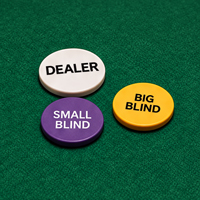
- The dealer button marks the nominal dealer and sets the order of action. Small blind and big blind buttons prevent mistakes.
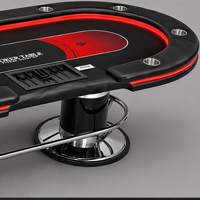
- The surface: a poker mat lets cards glide and stops chips from rolling; a folding poker table offers real comfort for regular games.
For clubs and events, custom ceramic poker chips in your association’s colours are the benchmark.
3. Small blind, big blind: how does the betting start?
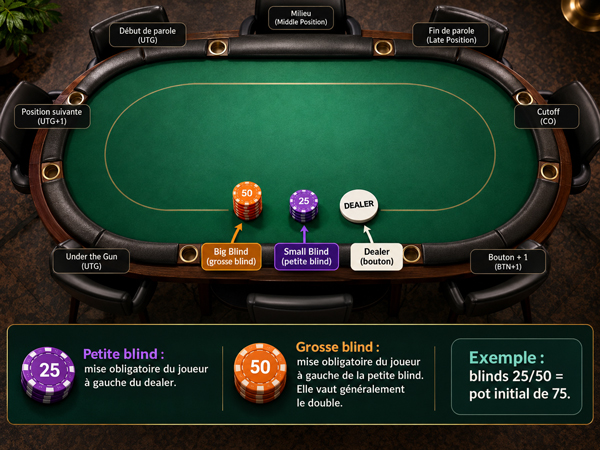
Before the deal, two players post forced bets: the small blind, to the left of the dealer button, then the big blind, to the left of the small blind. The big blind is usually twice the small blind. These forced bets create a pot to fight for from the outset: without them, everyone could simply wait for a perfect hand.
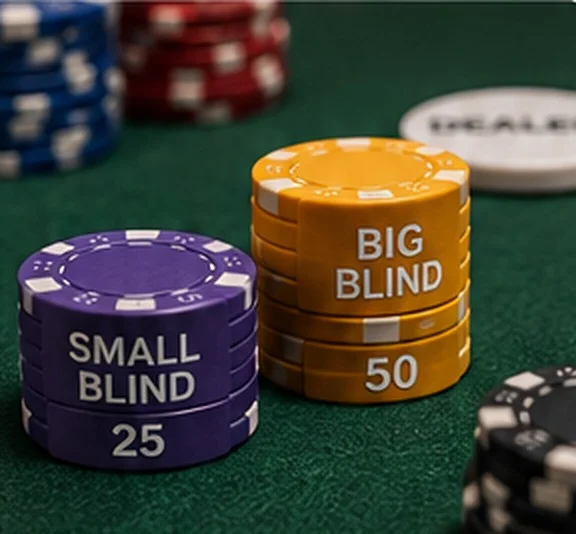
Example: with 25/50 blinds, the small blind puts in 25 and the big blind 50. The pot therefore starts at 75. After each hand, the dealer button moves one seat to the left, clockwise, so every player pays the blinds in turn.
The ante: in most tournaments, an extra bet is added from a certain level onward. The most common format today is the big blind ante: the player in the big blind pays the ante for the whole table, usually equal to the big blind. This speeds up play and avoids forgotten antes.
A player can’t cover their blind? They post whatever they have left and are all-in. They can then only win the part of the pot that matches their bet (see side pots).
4. How a hand plays out: preflop, flop, turn and river
Step 1 — Shuffle and deal
The dealer shuffles thoroughly, offers the cut to the player on their right, then deals one card at a time starting with the small blind, clockwise, until everyone has two cards. The cards stay face down and only their owner may look at them, lifting them slightly without taking them off the table.
Step 2 — Preflop
The first betting round begins. With three or more players, the first to act is the player to the left of the big blind (the position known as UTG). Each player may fold, call the big blind or raise. The blinds count as bets already made: if nobody has raised, the small blind only needs to complete to call, and the big blind may check or raise when the action comes back round. This is the only situation in which a player has this “option”.
Step 3 — The flop
The dealer burns a card (sets it aside face down, which prevents anyone profiting from a marked or glimpsed card), then turns over three community cards. The second betting round starts with the first active player to the left of the button. As long as nobody has bet, everyone may check.
Step 4 — The turn
Another card is burned, then a fourth community card is revealed. A third betting round takes place, in the same order. In Limit, bet sizes double from this round onward.
Step 5 — The river
After burning a third card, the dealer reveals the fifth and final community card. Every player now knows their final hand. The last betting round begins.
Step 6 — The showdown
If at least two players are still in the hand after the river betting, they turn over their cards. Showdown order: the last player to bet or raise on the river shows first; if everyone checked, it is the first active player to the left of the button. A beaten player may throw their cards away without showing them (muck), but then gives up the pot for good. The best five-card hand wins; in the event of an exact tie, the pot is split.
A betting round ends when all players still in the hand have put in the same amount (or are all-in) and everyone has had the chance to act after the last raise.
5. The 10 Texas Hold’em hand rankings
The rankings are the same as in traditional poker. The last column shows the probability of ending up with that hand over 7 cards (2 hole cards + 5 community cards): the rarer a hand, the stronger it is.
| Rank | Hand | Example | Definition | Probability (7 cards) |
|---|---|---|---|---|
| 1 | Royal flush | A♠ K♠ Q♠ J♠ 10♠ | Ace, King, Queen, Jack, 10 of the same suit | 0.003% |
| 2 | Straight flush | 9♥ 8♥ 7♥ 6♥ 5♥ | Five consecutive cards of the same suit | 0.03% |
| 3 | Four of a kind | 9♠ 9♥ 9♦ 9♣ K♠ | Four cards of the same rank | 0.17% |
| 4 | Full house | Q♠ Q♥ Q♦ 7♣ 7♥ | Three of a kind plus a pair | 2.6% |
| 5 | Flush | A♥ J♥ 8♥ 5♥ 2♥ | Five cards of the same suit | 3.0% |
| 6 | Straight | 5♠ 6♥ 7♦ 8♣ 9♠ | Five consecutive ranks | 4.6% |
| 7 | Three of a kind | 8♠ 8♥ 8♦ K♣ 4♥ | Three cards of the same rank | 4.8% |
| 8 | Two pair | K♠ K♥ 5♦ 5♣ 9♠ | Two different pairs | 23.5% |
| 9 | One pair | A♠ A♥ 10♦ 7♣ 3♠ | Two cards of the same rank | 43.8% |
| 10 | High card | A♠ J♦ 9♥ 5♣ 3♠ | None of the hands above | 17.4% |
Key points:
- The suits (spades, hearts, diamonds, clubs) are of equal value: a spade never beats a heart.
- The Ace is the highest card, but it can play low in the straight A-2-3-4-5 (the lowest straight, called the wheel). There is no wrap-around: Q-K-A-2-3 is not a straight.
- A hand is always five cards, no more. Six hearts do not make a “super flush”: only the five highest count.
- The royal flush is simply the highest straight flush, not a separate category.
6. Ties and kickers: who wins when two hands look alike?
When two players hold the same category of hand, precise rules decide between them. This is where many disputes between beginners arise.
- Pair against pair: the higher pair wins. With equal pairs, the three remaining cards are compared one by one, from highest to lowest. These cards are called kickers.
- Two pair: compare the top pair first, then the bottom pair, then the fifth card.
- Three of a kind and four of a kind: the higher one wins; if they are identical (possible when trips or quads are on the board), the kickers are compared.
- Full house: compare the three of a kind first, then the pair. Kings full of 2s beats Queens full of Aces.
- Straight: the highest card of the sequence decides. Two 9-high straights tie, whatever the suits.
- Flush: compare the highest card, then the second, and so on down to the fifth.
Example 1 — the kicker: board A♣ 9♦ 7♠ 4♥ 2♣. Player 1: A♠ K♦. Player 2: A♥ Q♣. Both have a pair of Aces, but player 1’s King beats player 2’s Queen. Hand 1: A-A-K-9-7; hand 2: A-A-Q-9-7.
Example 2 — playing the board: board K♠ K♥ Q♦ Q♣ J♠. Player 1: 8♦ 3♣. Player 2: 10♥ 9♥. Neither player improves on the Kings-and-Queens two pair with the Jack on the board: both hands are K-K-Q-Q-J and the pot is split. Had player 2 held an Ace, they would have won with K-K-Q-Q-A.
Odd chip: if a split pot cannot be divided exactly, the leftover chip goes to the first winning player to the left of the button.
7. How to bet: check, bet, call, raise, fold, all-in
- Check: pass without betting, only possible if no bet has been made in the current round.
- Bet: open the betting in a round. In No Limit, the minimum bet equals the big blind.
- Call: match the current bet.
- Raise: increase the bet. A raise of a raise is called a re-raise (3-bet, then 4-bet).
- Fold: give up the hand and any chips already bet.
- All-in: put in all the chips you have.
The minimum raise
In No Limit, a raise must be at least equal to the bet or the last full raise in the same round. Example with 50/100 blinds: a player raises to 300 (+200). The next player who wants to re-raise must go to at least 500 (300 + 200). If a third player raises to 1,200 (+700), the next minimum raise becomes 1,900.
All-in for less than a full raise: a player can always go all-in, even for less than the minimum raise. But this incomplete raise does not reopen the betting for players who have already acted: they can only call or fold.
Other betting structures
- Pot Limit: the maximum bet equals the size of the pot, including the amount to call. With a pot of 300 and an opponent’s bet of 100, you can raise to a total of 600 (100 to call + 500 of pot).
- Limit: bets and raises are a fixed amount (for example 2 preflop and on the flop, 4 on the turn and river), usually with a cap of three or four raises per round.
8. All-ins and side pots: how are they calculated?
A player who is all-in can only win, from each opponent, the amount they have bet themselves. Anything above that goes into one or more side pots, contested only by the players who contributed to them.
Example: Alice goes all-in for 1,000. Bruno and Chloe, who have 3,000 each, also go all-in.
- Main pot: 1,000 × 3 = 3,000, contested by Alice, Bruno and Chloe.
- Side pot: (3,000 − 1,000) × 2 = 4,000, contested only by Bruno and Chloe.
If Alice has the best hand, she wins the 3,000 main pot; the side pot goes to the better of the other two. With several all-ins of different sizes, repeat the calculation starting from the smallest stack. At showdown, side pots are always awarded first, then the main pot.
9. A complete Texas Hold’em hand, step by step
Four players are playing a hand with 25/50 blinds. You are on the button and are dealt A♠ K♠.
- Preflop: the first player calls 50; you raise to 150. Both blinds fold and the first player calls the extra to make 150. The pot is 375 (25 + 50 + 150 + 150).
- Flop: A♥ 10♠ 4♣. You have a pair of Aces with the best possible kicker and a backdoor spade flush draw. Your opponent checks; you bet 200 and they call. Pot: 775.
- Turn: Q♠. You still have a pair of Aces, plus a spade flush draw (9 cards give you the flush) and a straight draw (a Jack gives you the Ace-King-Queen-Jack-10 straight). Both players check.
- River: 7♠. Your final hand is A♠ K♠ Q♠ 10♠ 7♠: an Ace-high flush, the best possible hand on this board (the nuts). Your opponent bets 300 and you call.
- Showdown: your opponent, who bet last, shows A♦ J♣, a pair of Aces. Your flush wins and you take the 1,375-chip pot.
On this board, raising on the river would have been better: you hold the best possible hand and can win more. Above all, this example shows that a hand changes a great deal between the flop and the river: you cannot judge its strength from the two hole cards alone.
10. Table positions: why do they matter?
After the flop, the order of action is fixed: the player on the button acts last. Acting after your opponents means knowing what they have done before you decide. This is the main structural advantage in Texas Hold’em.
| Position (9-handed table) | Name | Feature |
|---|---|---|
| Small blind | SB | Pays a forced bet, acts first after the flop |
| Big blind | BB | Pays a forced bet, acts last preflop |
| Early positions | UTG, UTG+1, UTG+2 | First to act preflop: play strong hands |
| Middle positions | Lojack, Hijack | Slightly wider range of hands |
| Cut-off | CO | Just before the button, an aggressive position |
| Button | BTN | Acts last on the flop, turn and river: the best seat |
Heads-up special case: with two players, the button posts the small blind, receives the second card of each round of dealing, acts first preflop and last on the following streets.
11. Which starting hands should beginners play?
There are 1,326 two-card combinations, grouped into 169 distinct starting hands. Most of them are not worth playing. To get started, a simple sort is enough:
- Premium hands: A-A, K-K, Q-Q, A-K. Raise almost every time.
- Strong hands: J-J, 10-10, A-Q, suited A-J, suited K-Q. Play them by raising, especially in late position.
- Speculative hands: small pairs (2-2 to 9-9) and suited connectors (8-7, 9-8 of the same suit). They win big pots when the flop hits them (three of a kind, straight, flush) and are best played in position.
- Hands to avoid: weak, unconnected offsuit cards such as 9-3, J-4 or Q-2.
As a benchmark, you are dealt a pocket pair about once in 17 hands, pocket Aces once in 221, and two cards of the same suit about one time in four.
12. Useful odds: outs, the rule of 2 and 4, pot odds
Outs are the remaining cards that improve your hand into one that is probably winning. With four hearts after the flop, there are 9 hearts left in the deck: you have 9 outs to the flush.
The rule of 2 and 4 gives a quick estimate of your chances:
- on the flop, with two cards to come: outs × 4;
- with only one card to come: outs × 2.
| Draw | Outs | Flop → river | Turn → river |
|---|---|---|---|
| Flush draw | 9 | ≈ 35% | ≈ 20% |
| Open-ended straight draw | 8 | ≈ 31.5% | ≈ 17% |
| Gutshot straight draw | 4 | ≈ 16.5% | ≈ 9% |
| Pocket pair to set | 2 | ≈ 8.5% | ≈ 4.5% |
Pot odds compare what you have to pay with what you can win. Example: the pot is 400 and your opponent bets 200 on the turn. You must pay 200 for a final pot of 800: you need at least a 25% chance of winning for a call to be profitable. With a flush draw (about 20% with one card to come), calling loses money in the long run, unless you expect to win much more when the flush comes in.
13. Table rules and disputed situations
Most arguments at the table come from a handful of recurring situations. Here are the conventions used in clubs and casinos, to be adapted by announcing your house rules before the game.
- Act in turn: acting out of turn gives away unfair information. In clubs, an out-of-turn action is generally binding if the situation has not changed when the action reaches the player.
- Verbal declarations are binding: saying “raise to 400” commits you to betting 400. Announce your action before touching your chips.
- One motion: a bet is placed in one go. Going back to your stack for more chips without having announced it (string bet) is not allowed: only the first part counts.
- A single oversized chip: putting out one higher-value chip without saying anything counts as a simple call. To raise, you must announce it.
- Don’t throw chips into the pot: place your bet in front of you so that everyone can check it.
- Card exposed during the deal: if one of the first two cards dealt is turned face up by mistake, the deal is normally restarted; after that, the card is replaced and shown to everyone.
- Cards speak: at showdown, it is the hand actually shown that counts, not what the player announces. A hand that has been thrown away and mixed with the discards is dead.
- All-in and showdown in tournaments: when a player is all-in and no further betting is possible, all hands still in play are turned face up before the rest of the board is dealt.
- One player to a hand: no advice or comments on a hand in progress, even after folding.
14. Tournament or cash game: what’s the difference?
| Tournament | Cash game | |
|---|---|---|
| Chips | Tournament units, with no direct cash value | Defined cash value |
| Blinds | Increase by levels | Fixed |
| End of the game | Elimination down to the last player | Players leave when they like, within the rules |
| Buying more chips | Depends on the format (rebuy, re-entry, freezeout) | Allowed between hands |
| Ranking | Prizes shared among the top finishers | Everyone leaves with their stack |
Other formats exist: the Sit & Go (a single-table tournament that starts as soon as it is full), the three-player Spin and turbo tournaments with very short levels. For beginners playing with friends, a small tournament with no money at stake remains the simplest format.
15. How to run a home poker tournament
For a 6- to 8-player tournament lasting about three hours, here is a proven setup: a starting stack of 5,000 chips and 20-minute levels.
Chips per player: 8 × 25, 8 × 100, 4 × 500 and 2 × 1,000, i.e. 22 chips for 5,000. For 6 players you therefore need 132 chips; for 8 players, 176.
| Level | Small blind | Big blind |
|---|---|---|
| 1 | 25 | 50 |
| 2 | 50 | 100 |
| 3 | 75 | 150 |
| 4 | 100 | 200 |
| 5 | 150 | 300 |
| 10-minute break: the 25 chips, no longer needed, are removed (“colour up”) | ||
| 6 | 200 | 400 |
| 7 | 300 | 600 |
| 8 | 400 | 800 |
| 9 | 600 | 1,200 |
| 10 | 800 | 1,600 |
| 11 | 1,000 | 2,000 |
Practical tips: draw seats at random, appoint a dealer or rotate the deal with the button, display a timer everyone can see and announce the house rules (minimum raise, shown hands, rebuys allowed or not) before the first deal. For 6 players, a 300-chip case is enough; beyond that, move up to 500 chips.
16. Five common beginner mistakes
- Playing every hand: a weak starting hand is hard to defend and costly over time.
- Ignoring position: playing the same hands in early and late position means giving up information.
- Overrating a pair: on a board with three cards of the same suit or four connected cards, a pair of Aces can be far behind.
- Calling without doing the maths: always compare the bet you face with your chances of improving (see pot odds).
- Bluffing at random: a bluff must tell a story consistent with your previous actions and target opponents capable of folding.
17. Texas Hold’em poker glossary
- Board: the community cards in the middle of the table.
- Check-raise: checking and then raising when an opponent bets.
- Heads-up: a game or hand between two players.
- Kicker: side card that breaks a tie between two equal hands.
- Limp: entering the pot preflop by simply calling the big blind.
- Muck: the pile of discarded cards; throwing away your hand without showing it.
- Nuts: the best possible hand given the board.
- Outs: cards that improve your hand.
- Overcards: hole cards higher than every card on the board.
- Stack: the chips a player has.
- Straddle: an optional voluntary bet, usually twice the big blind, allowed in some cash games.
- Draw: an incomplete hand waiting for a card (flush draw, straight draw).
18. FAQ: common questions about Texas Hold’em rules
How many cards do you get in Texas Hold’em?
Each player receives two private cards. Five community cards are then revealed: three on the flop, one on the turn and one on the river.
How many people can play Texas Hold’em?
From 2 to 10 players per table. In tournaments, tables are usually 9-handed; above 10 players, a second table is opened.
Can you play Texas Hold’em with two players?
Yes. With two players, the button is also the small blind: it acts first preflop and last after the flop.
Do you have to use both hole cards?
No. The best hand can use zero, one or two hole cards. If the five board cards make the best hand, the board “plays” and the pot is split between the remaining players.
What is the best hand in poker?
The royal flush: Ace, King, Queen, Jack and 10 of the same suit. It occurs in about 0.003% of hands.
Does a flush beat a straight?
Yes. A flush (five cards of the same suit) is rarer than a straight (five consecutive ranks), so it is stronger. A full house beats a flush.
Who wins if two players have a pair?
The higher pair wins. If the pairs are equal, the kickers are compared in descending order. If all five cards are identical, the pot is split.
Is one suit stronger than another?
No. In Texas Hold’em, spades, hearts, diamonds and clubs all have the same value. Two hands identical except for suit are a tie.
What is the minimum raise in No Limit?
A raise must at least equal the bet or the last full raise in the round. If a player bets 200, the next raise must be to at least 400; if another player then raises to 700, the minimum raise becomes 1,200.
What happens if a player goes all-in with fewer chips than the others?
They can only win what they were able to cover from each opponent. The extra bets form a side pot contested by the other players.
Can a player win without showing their cards?
Yes. If every opponent folds, the last player wins the hand with no showdown required.
How many chips do you need for a tournament with friends?
Allow 20 to 25 chips per player. A 300-chip case is suitable for up to 6 players, a 500-chip case for up to 10 players.
19. Getting equipped for a home game
For a first game night, choose 100% plastic cards, easy-to-tell-apart chips and a stable mat. Regular players can opt for a dedicated poker table, while clubs can have custom chips made in their association’s colours. To go further, read our casino mats guide and our guide to choosing a table.
Find poker chip cases, poker chips, custom chips and plenty of accessories to run your games at Cartes-Production.com.
Conclusion: the Texas Hold’em rules to remember
Texas Hold’em rests on a few simple principles: two hole cards, five community cards, blinds to start the action and four betting rounds. You win with the best five-card hand or by making your opponents fold. Once you have mastered these basics, real progress comes from three levers: starting hand selection, using position and calculating the odds.